
International Shipping Packaging Guide for Ceramic Bathroom Vanity Cabinets with Mirrors
Shipping ceramic bathroom vanity cabinets with mirrors internationally requires professional export packaging to prevent damage caused by vibration, impact, and stacking during transit. This packaging guide covers the essential protection methods, including wrapping ceramic basins and mirrors with bubble wrap, securing the product in heavy-duty cardboard cartons, reinforcing it with sturdy wooden crates, and applying clear fragile handling labels. Following these international packaging practices helps reduce shipping damage, protects fragile bathroom furniture, and ensures safe delivery to customers worldwide.
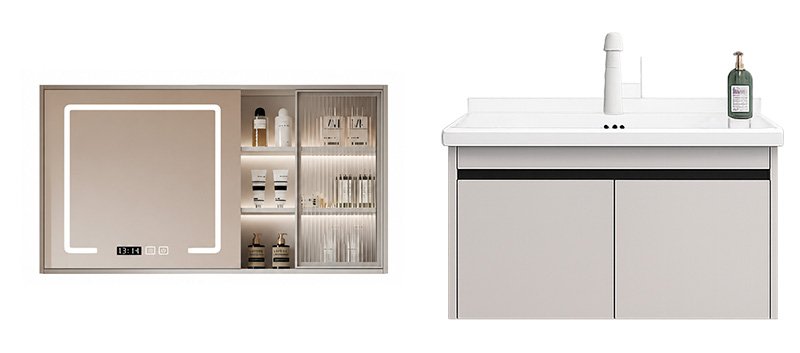
To ensure safe export transportation, professional protective packaging is essential. The following packaging procedures are highly recommended:
1. Bubble Wrap Protection (First Layer)
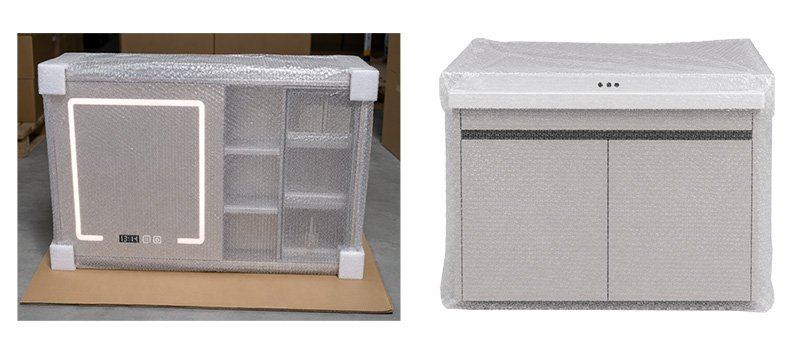
Begin by wrapping the entire mirrored vanity cabinet with thick bubble wrap. The mirror itself should receive several additional layers of bubble wrap for maximum protection. All corners should be reinforced with EPE foam corner protectors or pearl cotton (EPE) edge guards to absorb shocks and vibrations during transportation.
Countertops made of ceramic, marble, or sintered stone must also be carefully protected against impacts and vibration. Bubble wrap provides excellent inner-layer cushioning and isolation, making it one of the most effective materials for preventing surface damage and cracks.
2. Corrugated Carton Packaging (Second Layer)
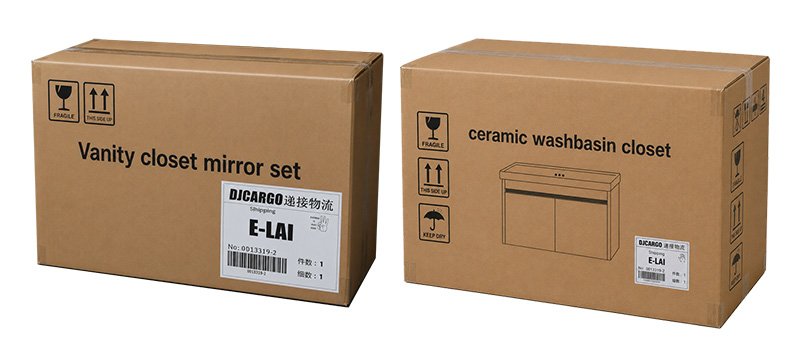
After the bubble wrap has been applied, place the mirrored vanity cabinet or ceramic bathroom vanity into a heavy-duty 5-ply or 7-ply corrugated cardboard carton.
Any empty space inside the carton should be completely filled with foam boards, EPE foam sheets, pearl cotton, or other cushioning materials to prevent movement during transportation. Proper internal cushioning keeps both the mirror and the vanity securely fixed in place and minimizes the risk of damage caused by vibration or shifting.
3. Plywood Frame or Plywood Crate Protection (Third Layer)
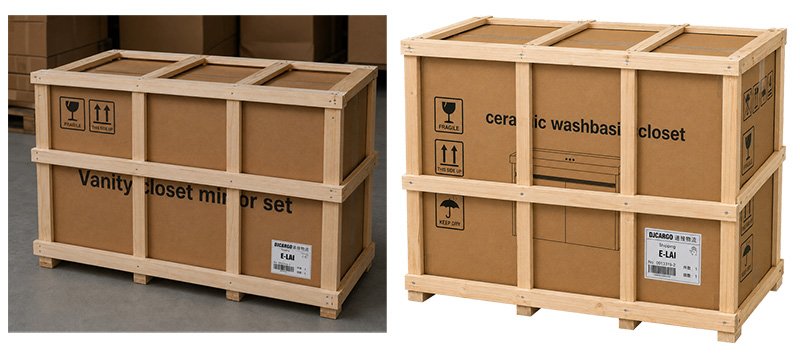
A strong plywood frame should be installed around the outside of the carton to provide additional protection. The plywood frame should be manufactured from export-grade plywood or ISPM 15-compliant treated wood, enabling it to withstand stacking pressure, handling, loading, unloading, and long-distance ocean transportation.
Because mirrored vanity cabinets and ceramic bathroom vanities are generally not excessively heavy, a plywood frame is usually sufficient and forklift openings are not required.
However, if an individual package weighs more than 50 kg, forklift openings should be incorporated into the plywood frame or plywood crate, since the package can no longer be safely handled manually and must be loaded and unloaded using a forklift.
For cargo weighing over 100 kg per package, a fully enclosed plywood case is the most suitable packaging solution. It provides the highest level of protection against impact, compression, and rough handling throughout international transportation.
4. Fragile Labels and Shipping Marks
After packaging is complete, clearly attach “FRAGILE” labels on all visible sides of the plywood frame or plywood case. Transportation handling labels such as “HANDLE WITH CARE” and “THIS SIDE UP” should also be prominently displayed.
These internationally recognized shipping marks immediately alert trained warehouse workers, forklift operators, and logistics personnel to handle the shipment with extra care. Fragile labels and shipping marks are standard requirements for international transportation of breakable goods and significantly reduce the risk of mishandling.
When these professional packaging procedures are followed, bathroom vanity cabinets with mirrors, ceramic countertops, marble countertops, and sintered stone countertops can achieve up to a 99% safe delivery rate from China to overseas destinations, arriving in intact condition.